The stack and the queue in STL

Tue Sep 29 2026
8 mins
Stack
Quick recap - what is the stack
A stack is a data structure that follows the LIFO principle - Last in, First out. In order to implement the structure, we can use a vector for maximum time efficiency or a linked list for maximum space efficiency. The stack has two operations: inserting an element on top (it is called the push operation) and deleting the last element that was inserted (called the pop operation).
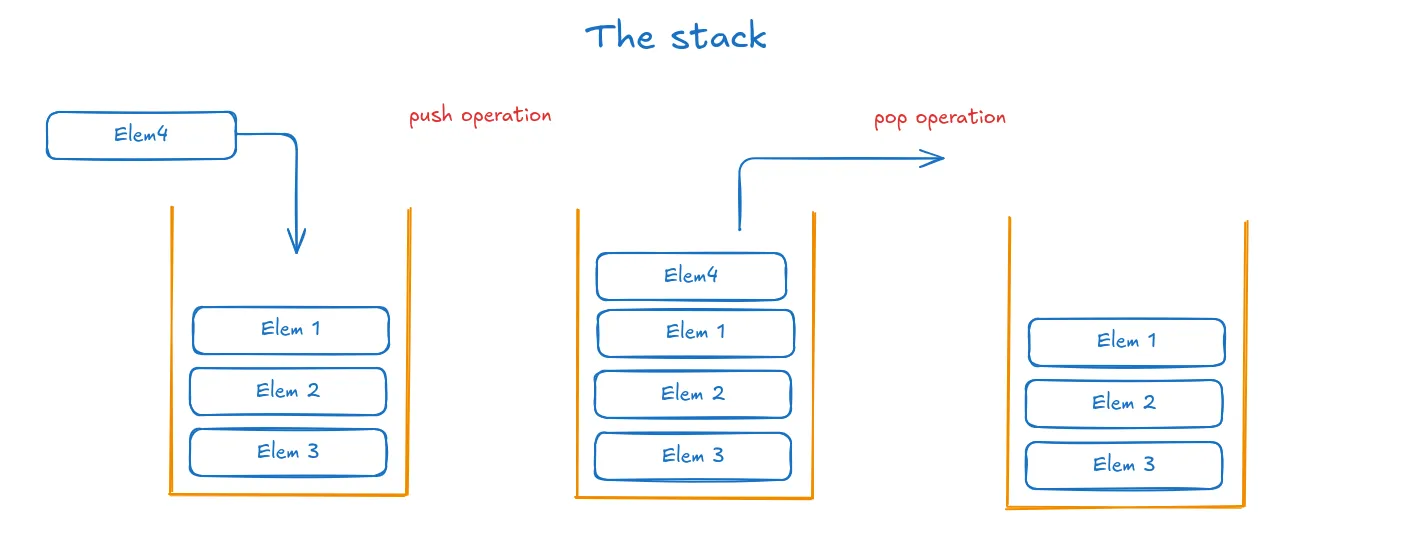
Time complexity for common operations of the stack
Revision - implementing the stack in C
See code
    typedef struct Stack
    {
        int *data;
        int capacity, top;
    } Stack;

    // init the structure
    Stack *initStack(int capacity)
    {
        Stack *s = malloc(sizeof(Stack));
        s->capacity = capacity;
        s->top = -1;
        s->data = malloc(s->capacity * sizeof(int));
        return s;
    }

    // is empty
    int isStackEmpty(Stack *s)
    {
        return s->top == -1;
    }

    // push - inserting an element as the last
    void push(Stack *s, int elem)
    {
        if (s->top == s->capacity - 1)
            return; // not enough space on the stack

        s->top++;
        s->data[s->top] = elem;
    }

    // pop - deleting the last element
    int pop(Stack *s)
    {
        if (s->top == -1)  // stack is already empty
            return -99999; // or other err code

        int val = s->data[s->top];
        s->top--;
        return val;
    }
The stack in STL
In the Standard Template library the stack is implemented as a container adaptor, meaning that under the hood it uses the std::deque container
and it restricts its interface in order to enforce LIFO. We use the <stack> header which provides functions such as
push, pop, top, empty and size.
Declaration & Initialization
In order to initialize the stack at declaration we need to initialize the underlying container which is std::deque.
#include <stack>
#include <deque>
#include <list>

// stack<type> name_of_stack;

// examples:
std::stack<int> myStack;
std::stack<std::pair<int, char>> new_stack;
std::stack<int, std::list<int>> listStack;

// initialize
std::stack<char> s(std::deque<char>{'a', 'b', 'c'}); // a is the bottom, c is the top
Inserting and accessing elements
We can only insert elements at the top using the push method, while we can access only the last element using the top method.
#include <stack>
#include <iostream>
std::stack<int> s;

s.push(40);
s.push(50);
s.push(60);
std::cout << s.top(); // 60
Deleting elements and checking if the stack is empty
The stack only allows to remove the top element using the pop function, while checking using the empty method if the stack has an element or not.
#include <deque>
#include <stack>
#include <iostream>

std::stack<char> s(std::deque<char>{'a', 'b'});

s.pop();
std::cout << s.top(); // a
s.pop();
if(s.empty())
    std::cout << "empty"; // true
Traversing and finding size
We can only traverse the stack by deleting element by element or by creating a copy of it where we do the same procedure.
#include <stack>
#include <deque>
#include <iostream>

std::stack<int> s(std::deque<int> {1, 2, 3, 4});

cout << s.size() << std::endl; // 4

std::stack<int> temp(s); // making a copy

while(!temp.empty()){
    std::cout << temp.top() << ' ';
    temp.pop();
} // 4 3 2 1
Other useful methods
- stack1.swap(stack2) - efficiently exchanges the contents of the two stacks
- stack.emplace(element) - While push() copies or moves an existing object into the stack, emplace() constructs the object in-place directly inside the container
Queue
Quick recap - what is the queue
The queue is a data structure that functions by the FIFO principle - First in, First out. It can be implemented dynamically using a linked list, or statically by using a vector.
When implemented dynamically, the head of the linked list corresponds to the front of the queue, while the tail of the list corresponds to the back of the queue in order to allow O(1) deletions.
Likewise the stack, it implements three operations: enqueue (adding an element to the queue as the last), dequeue (eliminating the first element in the queue) and peek (getting the value of the first element).
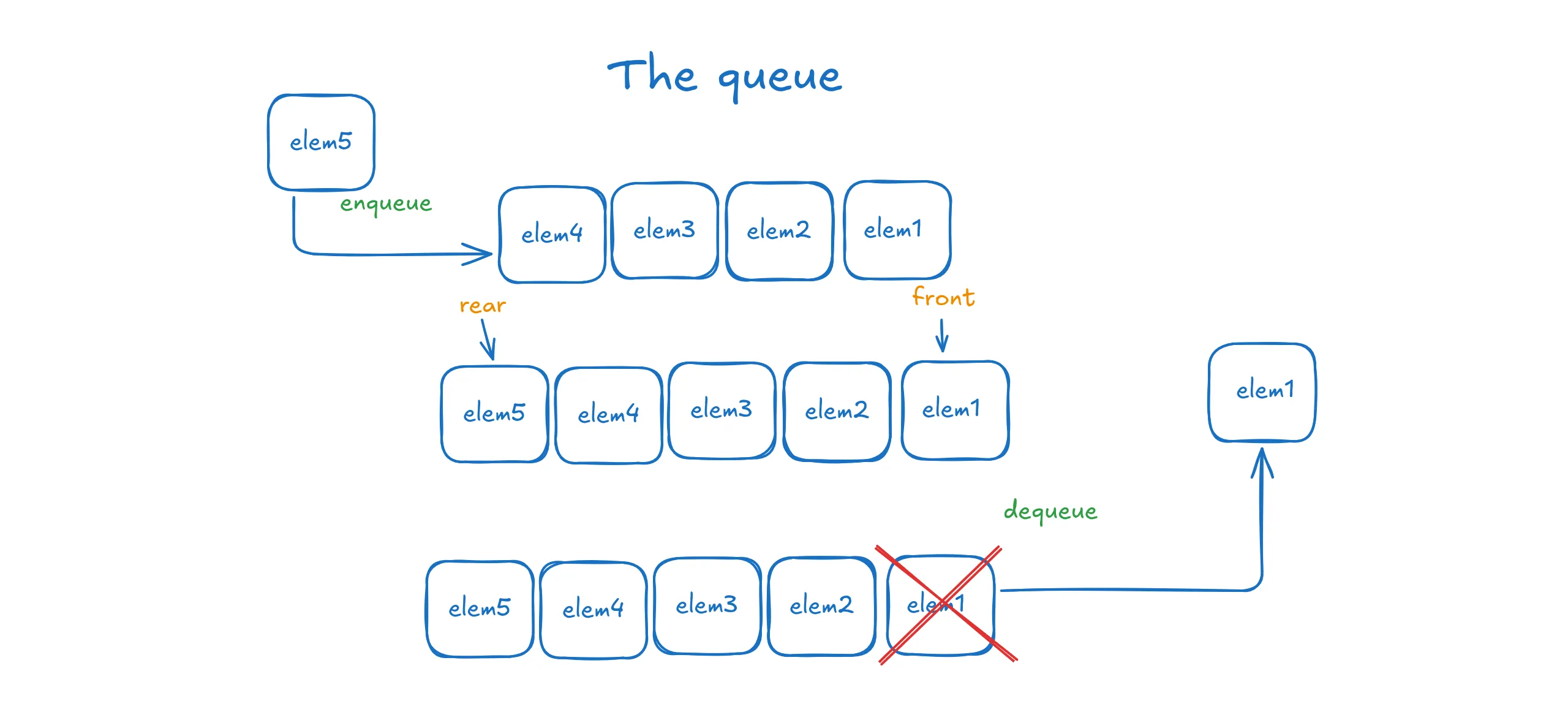
Time complexity for common operations of the queue
Revision - implementing the queue in C
See code
#include <stdio.h>
#include <stdlib.h>

typedef struct QueueCell
{
    void *data;
    struct QueueCell *next;
} QueueCell;

typedef struct Queue
{
    QueueCell *front, *rear;
} Queue;

Queue *initQueue()
{
    Queue *q = malloc(sizeof(Queue));
    q->front = q->rear = NULL; // initially no elements in the queue

    return q;
}

// adds the element at the rear
void enqueue(Queue *q, void *data)
{
    QueueCell *newCell = malloc(sizeof(QueueCell));
    newCell->data = data;
    newCell->next = NULL;

    if (q->rear == NULL)
    { // adding the first element
        q->front = q->rear = newCell;
    }
    else
    {
        q->rear->next = newCell;
        q->rear = newCell;
    }
}

// returns the value of the only accesible element - the first
void *peek(Queue *q)
{
    if (!q->front)
        return NULL;
    return q->front->data;
}

// eliminates the first element
void dequeue(Queue *q)
{
    // the queue is empty
    if (!q->front)
        return;

    QueueCell *cell = q->front;
    if (q->front == q->rear)
    {
        q->rear = q->front = NULL;
    }
    else
    {
        q->front = q->front->next;
    }
    free(cell);
}
The queue in STL
Likewise the stack, the queue is also implemented as a container adapter over std::deque.
We use the queue by including <queue> header which implement functions such as
push (enqueue), pop (dequeue), empty.
Declaration & Initialization
In order to initialize the queue at declaration, we need to initialize the underlying container, which is std::deque.
// Initialization structure
std::queue<element_type> queue_name;

// examples
std::queue<int> q1;
std::queue<std::pair<int, char>> pairQueue;
std::queue<int, std::list<int>> listQueue;

// Initialization
std::queue<int> q2(std::deque<int>{10, 20, 30}); // 10 is front, 30 rear
Inserting and accessing elements
Because of the FIFO principle, we can only add at the back using the push method, while we can access the first element (using front) and the last (using back).
std::queue<int> q;

q.push(40);
q.push(50);
q.push(60);

std::cout << q.front();     // 40
std::cout << q.back();      // 60
Deleting elements and checking emptiness
The queue only allows to delete the first element using the pop method, while checking if the queue is empty using the function with the same name.
std::queue<char> q(std::deque<char>{'a', 'b', 'c'});

q.pop(); // eliminate 'a'
std::cout << q.front(); // 'b'

q.empty(); // false
Traversing and finding size
We can only traverse the queue by deleting element by element (or creating a copy and doing the same procedure).
std::queue<int> q(std::deque<int> {1, 2, 3, 4, 5});

// finding size
std::cout << q.size(); // 5

// traversing
std::queue<int> cpyQ(q); // making a copy

while(!cpyQ.empty()){
    // using g.front();
    cpyQ.pop();
}
Other useful methods
- queue1.swap(queue2) - exchanges the contents of the two queues
- queue.emplace(element) - while push() copies or moves an existing object into the queue, emplace() constructs the object in-place directly at the back of the underlying container.